
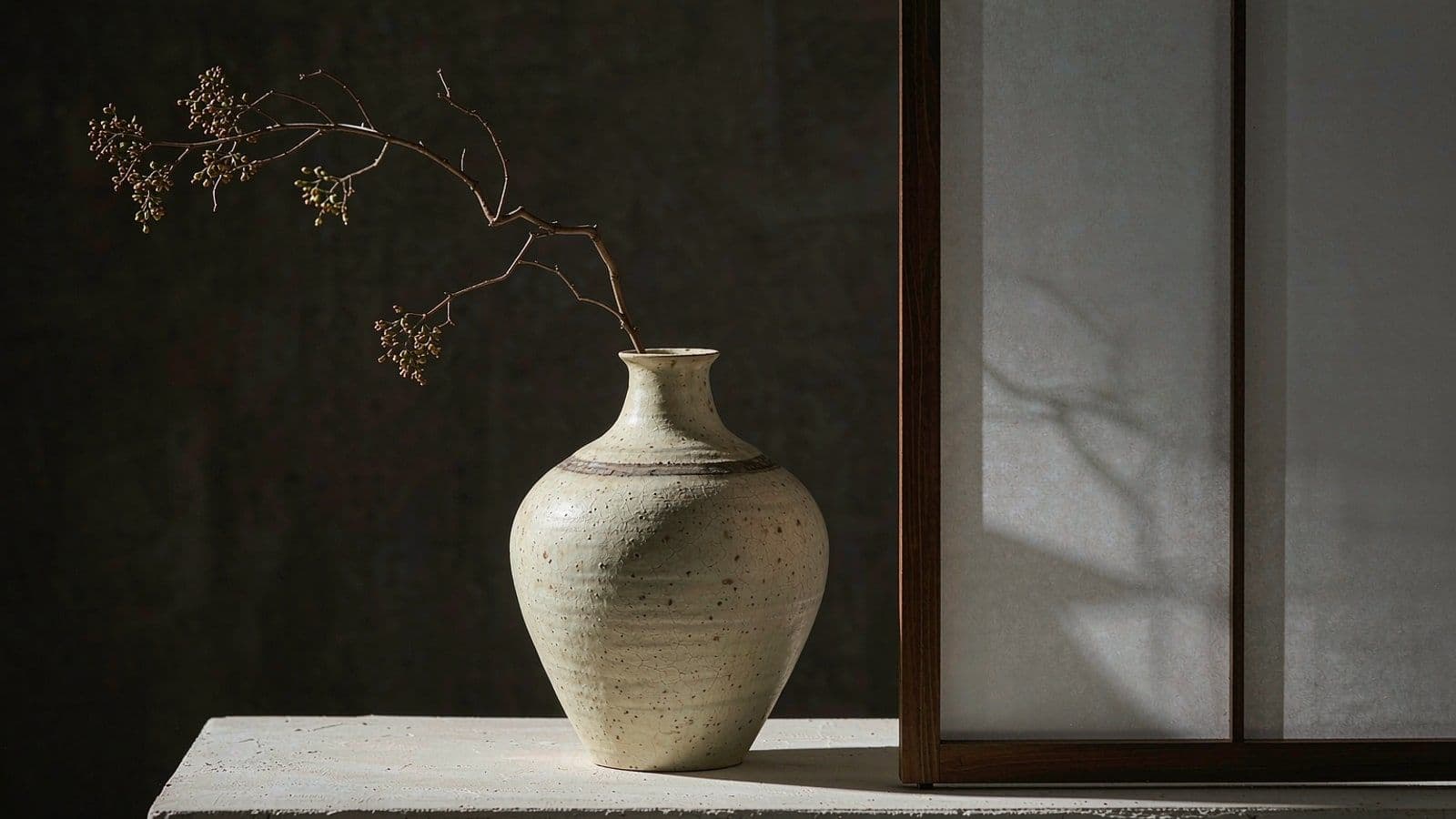
Hong Kong Desktop Wabi-Sabi Aesthetics: Plain-Colored Vases from Mong Kok Independent Ceramicists
A plain-colored vase turns the desk from a dumping ground back into a corner where you can pause. This article explains why wabi-sabi aesthetics suit Hong Kong's small spaces, where in Mong Kok you can find such objects, how to match vessel forms with settings, and how to care for them in a humid climate.
Where in Hong Kong can I find wabi-sabi-style plain-colored ceramic vases?
Independent ceramics studios and select-shop corners can be found in Mong Kok and adjacent neighborhoods. Allow 20–40 minutes, and choose a weekday afternoon or an earlier weekend slot, when the light is good for observing glaze and clay color. When choosing, check proportion first (tall, slim forms pair with thin branches; short, round forms pair with short stems and sit more stably), then the rim and glaze feel, and confirm whether it can hold water for daily use.
- •Wabi-sabi vases win through clay color, matte glaze, and irregular rims rather than bright glazes, so they wear well over time.
- •Mong Kok and adjacent neighborhoods cluster small studios and select-shop corners; weekday afternoons offer better light and fewer people.
- •Selection order: proportion → rim and feel → whether the color harmonizes with the desk → whether it can hold water → how to clean it.
- •Tall, slim forms suit thin branches; short, round forms suit short stems; the desk's center of gravity affects the look more than size.
- •Hong Kong's spring is humid; unglazed ware should go in a ventilated spot, and confirm whether it's glazed and waterproof before using with water.
In a city as fast-paced as Hong Kong, the desk is often the first thing to become a dumping ground: charging cables, delivery bags, unopened cardboard boxes, last week's receipts. To make it feel like a place you can sit down at again, the easiest move isn't to buy storage boxes — it's to clear a small empty spot and place one quiet object there.
A plain-colored vase is the lowest-cost, most direct-effect option among such objects. It doesn't grab attention with bright glazes; it relies on the color of the clay body, the matte surface, and that slight irregularity at the rim. This is how wabi-sabi aesthetics enter daily life: imperfect, unshowy, but seen every day.
A plain-colored vase doesn't change the surface area of your desk — it changes what you see first when you sit down.
What wabi-sabi is, and why it suits Hong Kong's small spaces
Wabi-sabi comes from Japanese aesthetics, and its core is accepting incompleteness, irregularity, and the traces left by time. Applied to pottery, it usually shows up in a few concrete practices: no glossy glaze, keeping the throwing rings, letting the rim rise and fall slightly, and revealing the natural graininess of the clay body.
This happens to suit Hong Kong's living conditions. Most desktops are only half a meter wide, and a matching set of three vases immediately looks crowded; a single plain-colored object, being small and low in color, can instead anchor the eye in a cramped space. More importantly, it doesn't need to be "styled" — it can coexist with a wooden desk, a white wall, old books, a monitor.
Another practical reason is that it wears well over time. Brightly colored decorations get tiresome within three months, because they release all their information at first glance. A plain-colored object hides its information in the details: the subtle shifts in glaze as light moves, the change in proportion when you arrange different stems and leaves — these take time to notice.
Why you can find such objects in Mong Kok
Mong Kok is often treated as shorthand for shopping and street markets, but it is also one of the densest clusters of small studios in Hong Kong. The rent structure lets independent ceramicists and small select shops tuck themselves into commercial buildings and old walk-ups; within walking distance of MTR Mong Kok Station (Tsuen Wan Line, Kwun Tong Line) or Mong Kok East Station (East Rail Line), you can find several such spaces.

This also means the way you explore is different from mall shopping. You're unlikely to find them via a big street-front sign; more often it's through floor directories, small lettering by the entrance, or the shopkeeper's recommendation. Slow the pace a little, and you're more likely to come across them.
If you came to know such objects through UNBOX's experience clues, you can first confirm the exact location and opening hours in the App's "Discover" section, then plan your route; the in-siteMong Kok neighborhood guidealso provides the street structure of this area.
How to schedule a visit
Looking at objects doesn't need a whole day, but it doesn't fit well squeezed between two appointments either. Here's a roughly 40-minute rhythm, suitable for a first visit.
Time | What to do | Why this arrangement |
|---|---|---|
0–10 min | Walk around first, don't touch anything | Establish a reference for price and style, avoid buying at first glance |
10–25 min | Pick 3–4 pieces to handle and compare | Weight, rim, and base stability can only be judged by feel |
25–35 min | Ask three questions | Can it hold water, how to clean it, is it moisture-resistant |
35–40 min | Decide or leave | Your mood that day easily affects judgment; if hesitant, don't buy yet |
As for timing, a weekday afternoon or an earlier weekend slot is best: natural light comes in from the side, so the matte glaze and graininess are clearly visible; there are also fewer people, so you can weigh the forms in peace. Weekend evenings are when Mong Kok is most crowded, and looking at things is easily interrupted.
The five-step selection order
Breaking the selection into a fixed order keeps you from being led along by "it looks nice." The order matters, because the earlier the item, the harder it is to change.
- Check proportion: the relationship between height and mouth diameter determines what flowers it suits. Tall, slim types suit one or two thin branches; short, round types suit short stems and small bunches.
- Check the rim: run your fingertip around the rim — are there burrs, does it scratch your hand? The rim is the spot most easily chipped.
- Check the glaze and clay color: matte, semi-matte, or unglazed. Unglazed feels rough but absorbs water readily, so be careful when using it with water.
- Check stability: give the body a gentle push — does the base sit flat on the table? Short, round forms have a low center of gravity and sit more stably on a desk.
- Ask about use: can it hold water for daily use, how to clean it, is it suitable for a humid environment.
As for color, off-white, gray, and earth tones are the three safest directions — they won't clash with wooden desktops, paper, or screens. If your furniture is on the darker side, you can try a piece with a slight kiln variation in gray-blue — kiln variation refers to the natural differences in depth of glaze color produced during firing, so no two pieces are exactly the same.
How to match vessel forms with settings
The same vessel form placed in different spots makes a big difference. The table below shows four common combinations; you can compare them against your own desk conditions.
Vessel form | Suitable flowers | Suitable location | Things to note |
|---|---|---|---|
Tall, slim type (small mouth, tall body) | One or two thin branches, a single dried flower | Side of the desk, beside a bookshelf | High center of gravity; avoid placing where it's often bumped |
Short, round type (wide mouth, low body) | Short stems, small bunches of wildflowers | Center of the desk, coffee table | Wide mouth means water evaporates quickly; top up often |
Cylinder type | Leafy branches, can hold more | Entryway, windowsill | Visually heavy; looks crowded on a small desk |
Irregular hand-pinched type | Left empty or a single stem | As a standalone decorative object | Uneven rim; branches are hard to secure when arranging |
Care in Hong Kong's climate
Hong Kong's spring humidity stays high for long stretches, and during the returning-south dampness both walls and floors sweat, which affects pottery in two ways: first, unglazed ware absorbs moisture easily; second, standing water leaves scale and odors over time.
- For unglazed (unglazed) objects, place them in a ventilated spot and avoid keeping them against the wall for long periods, to prevent the back from getting damp.
- Before using with water, confirm whether it is glazed and waterproof; unglazed vessels are better suited to dried flowers or purely as decorative objects.
- Change the water weekly and rinse the inner wall to prevent a slippery film of bacteria from forming.
- Avoid direct sunlight and direct airflow from air-conditioning vents; large temperature swings can cause fine cracks in the glaze.
If white scale appears on the body, soak it in warm water with a little white vinegar and then rinse — don't use steel wool; once a matte glaze is scratched, the marks can't be repaired.
Budget and price expectations
Prices for independent ceramic work vary widely, depending on size, firing difficulty, and the maker's output. This article doesn't list specific figures, for a simple reason: even the same maker's prices change from batch to batch, and writing them down would only mislead. A safer approach is to set an upper limit for your range, look at the price tags of three pieces when you enter the shop, and then decide whether to keep looking.
If your budget is limited, there are two alternatives: choose a smaller single-stem vessel, or choose a "second" with a slight flaw that doesn't affect use — in wabi-sabi aesthetics, a flaw itself isn't a demerit.
Placement: three spots, three common mistakes
Placement affects how something looks more than the object itself. Three relatively safe spots are: the corner of the desk on the side where you sit most often, the gap between the bookshelf and the wall, and a small surface in the entryway that you see when you turn around. What they share is that they're all where your gaze lands, but not on your path of movement.
- Mistake one: placing it directly in front of the monitor. The object will constantly distract you, and two weeks later you'll only feel it's in the way.
- Mistake two: displaying three pieces at once. The strength of a plain-colored object comes from empty space; three pieces cancel each other out.
- Mistake three: placing it in direct sun by the window. Long exposure to strong light fades the glaze, and the clay body also dries and cracks easily.
Frequently asked questions
Do I have to buy an independent ceramicist's work?
Not necessarily. Mass-produced objects have advantages in size consistency and price, and are good for testing the waters. The value of independent work is that each piece's proportions and glaze differ slightly, so you can find the feeling of "this is the one." Both are reasonable, depending on whether you care about consistency or uniqueness.
Can unglazed ware hold fresh flowers directly?
Not recommended. An unglazed clay body absorbs water, and water will seep through the vessel walls, easily leaving water marks and odors with long-term use. If you want fresh flowers, choose a glazed or semi-glazed form; unglazed ware is better for dried flowers, branches, or left empty.
Are there other places to look besides Mong Kok?
Yes. The old districts around Sheung Wan also have small ceramics and select-shop spaces, with a slower pace than Mong Kok, good for combining with a walk. You can cross-reference withTea and coffee in Sheung Wanand plan that route for half a day.
Next steps
If you want to turn "looking for objects" into a complete afternoon, you can combine it with a Mong Kok neighborhood route; if you want to understand how this kind of experience gets packed into a box, readWhat is UNBOX. More neighborhood clues are inDiscover.
Key facts
- Neighborhood
- Mong Kok, Kowloon, Hong Kong
- How to get there
- MTR Mong Kok Station (Tsuen Wan Line / Kwun Tong Line); Mong Kok East Station (East Rail Line)
- Suggested duration
- 20–40 minutes
- Best time
- Weekday afternoons or earlier weekend slots, good for observing glaze and clay color
- Who it suits
- People looking to upgrade their desk aesthetics, visitors, creators who like quiet objects
- Vessel form suggestions
- Tall, slim forms suit thin branches; short, round forms suit short stems and sit more stably on a desk
- Buying tips
- Check proportion first, then the rim and glaze feel; off-white / gray / earth tones coexist most easily with wooden desks; and confirm whether it can hold water for daily use
- Care tips
- Hong Kong's spring is humid; unglazed ware should go in a ventilated spot; confirm whether it's glazed and waterproof before using with water
- Price and stock
- Subject to on-site information at the studio or select shop
Sources
Related stories

How do beginners choose their first blind box? A UNBOX starter guide
How to choose your first blind box without pitfalls: first think clearly about whether it's for yourself or as a gift, confirm your budget tier, then decide whether you prefer physical items or city experiences. This article gives three beginner paths, a pre-order checklist, and tips on using experience vouchers after unboxing.

How to give a blind box as a gift? Choosing by budget, occasion, and recipient preference
Who is a blind box suitable for, and who isn't it for? How to set a budget, match the occasion, and avoid "gave it but never used it"? This article offers a three-step test, four typical recipient profiles, and common mishaps, plus how to follow up after giving.