
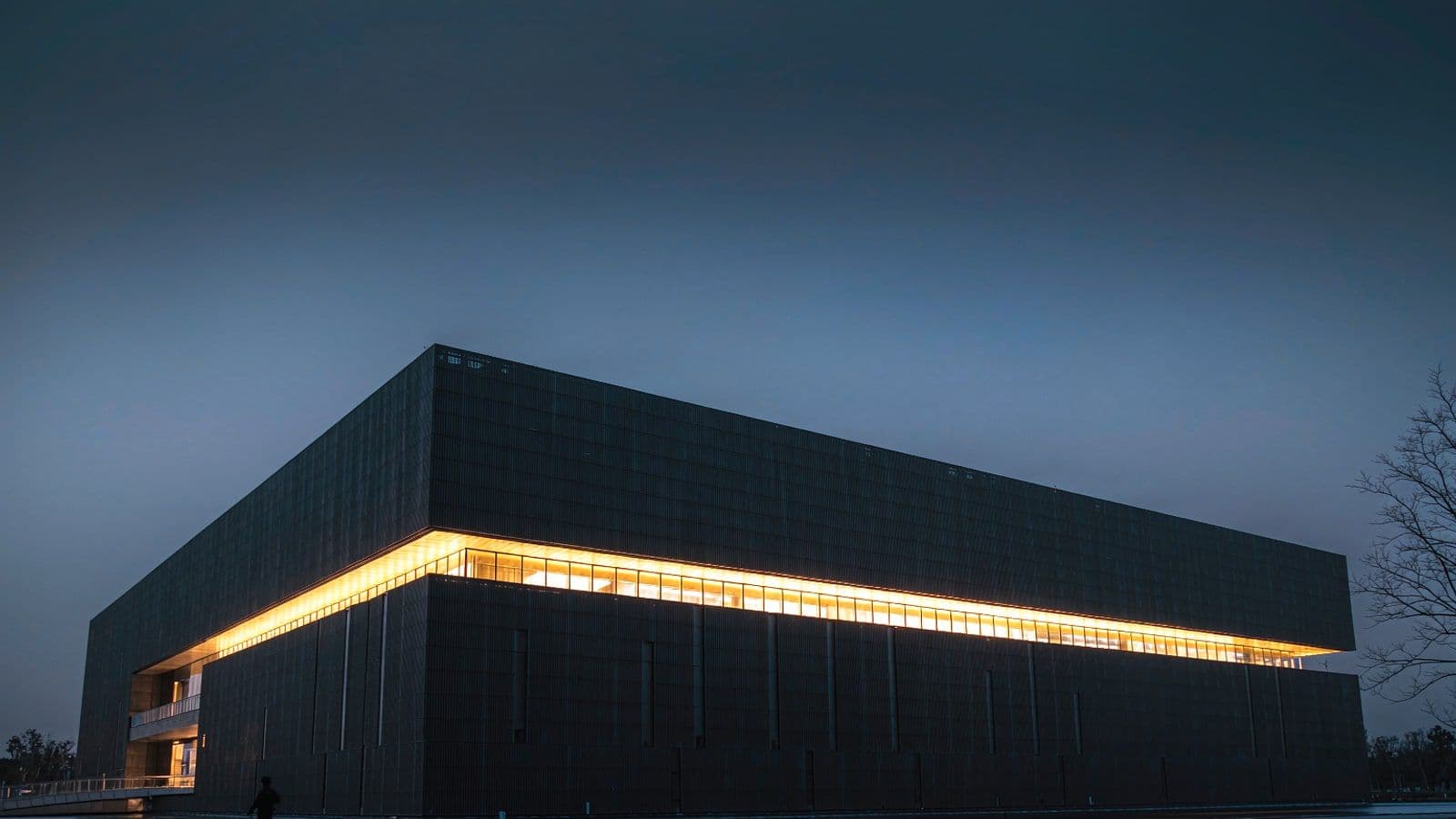
West Kowloon exhibitions: spending an afternoon between M+ and the waterfront promenade
M+ is the museum of visual culture in the West Kowloon Cultural District. Whether or not you understand the exhibitions doesn't really matter—what matters is that it gives Hong Kong an indoor space where you can comfortably spend a whole afternoon. This article offers a relaxed half-day route and an energy allocation table.
How to visit M+ without getting tired? How to plan a half day in West Kowloon?
M+ is located at 38 Museum Drive, West Kowloon Cultural District, Kowloon, about 10–15 minutes on foot from MTR Kowloon Station or Austin Station. It's open Tuesday to Sunday and closed Mondays (subject to the official website). It's recommended to see just 1–2 galleries per visit, spend 2–2.5 hours on exhibitions, then leave 40 minutes for the waterfront promenade.
- •M+'s galleries are large and the routes are long; seeing them all in one visit is about as physically tiring as walking through a mid-sized shopping mall.
- •The right strategy is to pick just 1–2 galleries or special exhibitions, then leave—don't try to do too much.
- •Closed on Mondays; be sure to confirm the day's opening hours and special exhibition arrangements before you go.
- •Walking from Kowloon Station into West Kowloon takes about 10–15 minutes, and this stretch has no shade—take care in summer.
- •Walking 40 minutes along the waterfront promenade after the exhibitions is the most effective "reset" for the afternoon.
The West Kowloon Cultural District sits at the southern tip of the Kowloon Peninsula in Hong Kong, facing Victoria Harbour, and is the largest cultural infrastructure project of the past decade. Its advantage is low density—large open spaces are left between buildings, so walking through feels uncrowded; the trade-off is distance—walking from the MTR station to the museum entrance alone takes a good ten-plus minutes.
M+ sits at the center of this area, positioned as a museum of visual culture rather than just a traditional art museum. Its collection and exhibitions cover visual art, design, architecture, and moving image, so in a single afternoon you might see contemporary painting, the history of poster design, and an experimental film all at once.
The biggest barrier to seeing exhibitions isn't the ticket price—it's "deciding what to see." Narrowing the scope to one or two galleries actually makes it easier to go.
What is the West Kowloon Cultural District
The West Kowloon Cultural District is made up of several parts: M+, Freespace, the Art Park, and a waterfront promenade stretching along the coast. They are connected by walkways and can be traversed entirely on foot, but the span is considerable.
First-time visitors tend to make one mistake: treating the entire cultural district as a single "attraction" and trying to cover it all in one go. A more sensible approach is to treat it as a neighborhood and take just one section at a time—see an exhibition today, and come back next time just to walk along the waterfront.
What to see at M+: no fixed exhibitions in mind
Exhibition dates and ticket prices change constantly, so please check the M+ official website before you go. Here we only cover a few relatively stable points that determine how you should plan your time.
- The galleries are large and the routes are long. Seeing every gallery in one visit is about as physically tiring as walking through a mid-sized shopping mall.
- It's recommended to pick just 1–2 galleries or special exhibitions per visit, then leave—don't try to do too much.
- There are many large-scale works and moving-image pieces, so the time you spend sitting down to watch will be longer than you expect.
- Closed on Mondays; public holiday arrangements are subject to the official website—be sure to confirm before you go.
Item | Details | Notes |
|---|---|---|
Location | 38 Museum Drive, West Kowloon Cultural District, Kowloon | Facing Victoria Harbour |
Transport | MTR Kowloon Station or Austin Station | About 10–15 minutes on foot |
Opening | Tuesday to Sunday | Closed Mondays; subject to the official website |
Suggested stay | 2–2.5 hours for exhibitions | Excludes the waterfront promenade |
Best for | People who want a quiet afternoon | No art background needed |
Seeing several exhibitions in one visit: budget your energy first, then your interest
Museum fatigue is real. By the third gallery, you'll start looking at works with an eye for "how much is left" rather than "what is this." Rather than pushing through, plan your exit point in advance.
Route | Duration | Number of exhibitions | Best for |
|---|---|---|---|
Light | 2 hours | 1 gallery + 1 special exhibition | First-time visitors, those with children, those with other plans in the afternoon |
Standard | 3.5 hours | 2 galleries + 40 minutes by the water | The best option for most people |
In-depth | Half a day or more | 3 galleries + moving-image works | People with a clear interest in visual culture |
If you choose "Standard," it's best to put the one exhibition you most want to see first, because your attention is sharpest in the first hour. For the second gallery, pick one with a short route, then head straight out and save the rest of your energy for the outdoors.
The waterfront promenade: the other half beyond the exhibitions
Walking out of M+ toward the water brings you to the West Kowloon Waterfront Promenade. It's a long walkway with lawns, benches, and shade facilities, and many people bring mats and just sit.
The view of Victoria Harbour here is different from Tsim Sha Tsui: across the water is the stretch from Mid-Levels West to Central on Hong Kong Island, which lights up first in the evening. If your head is spinning from the exhibitions, this walk is the best way to reset—it doesn't require you to make any judgments, just keep walking forward.
One thing to note is shade. There aren't many trees along the promenade, so walking this stretch at midday in summer can be very sunny; in winter the sea breeze is strong and standing around gets cold. Bringing a jacket or a hat makes a big difference.
A workable afternoon route
The premise of this route is: you only have half a day, and you don't want to be too tired.
- 14:00 Arrive at MTR Kowloon Station and follow the signs on foot into the West Kowloon Cultural District.
- 14:30–17:00 See 1–2 exhibitions at M+, sitting down once inside along the way.
- 17:00–18:00 Leave the museum and walk a stretch south along the waterfront promenade.
- After 18:00, stay on the lawn to watch the sunset, or walk back to Kowloon Station and leave.
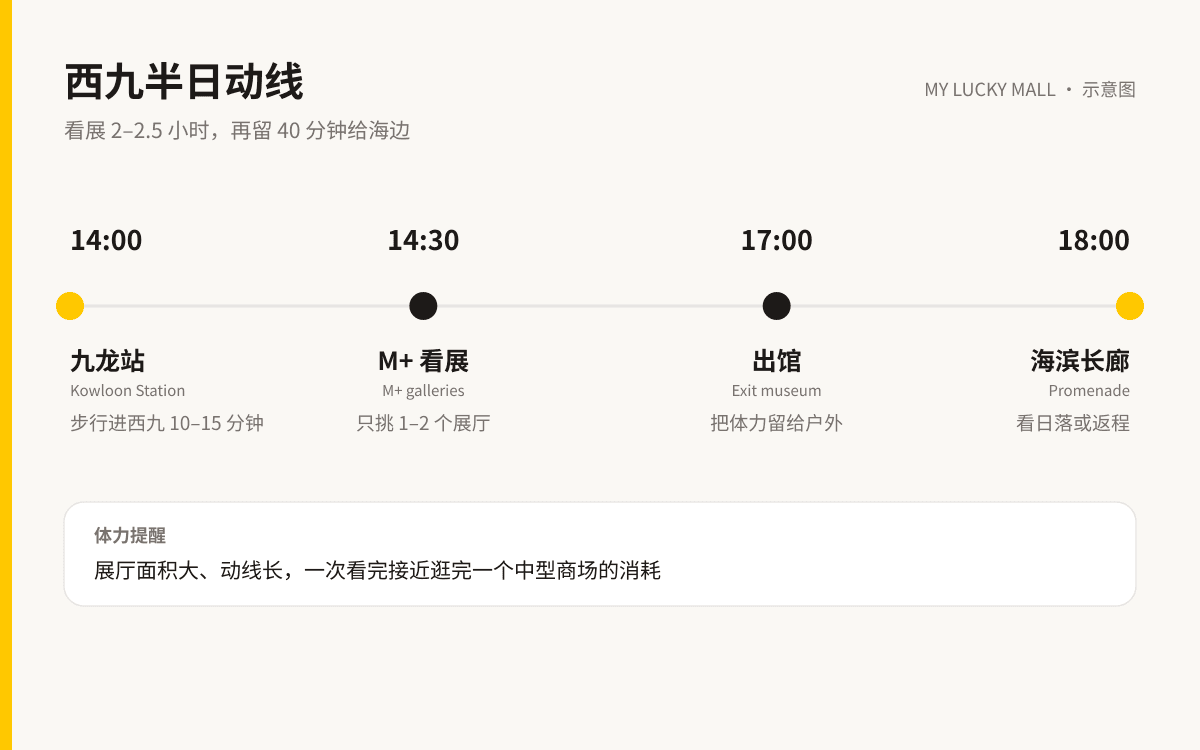
If you have good stamina, you can stretch the exhibition time to three and a half hours, but remember to leave at least 40 minutes for the waterfront. Otherwise you'll be indoors the whole afternoon, which can feel stuffy. Conversely, if you're not feeling great that day, cut the exhibitions to one hour and give all the remaining time to the promenade—you won't feel it's wasted.
A few details on transport and entry
Entering West Kowloon from Kowloon Station means taking connecting footbridges and ground-level walkways. There are signs the whole way, but you'll pass through a stretch of open space with no shops. For a first visit, allow 15 minutes and don't cut the timing too close.
- You can also enter from the Austin Station side; the distance is similar and it's usually less crowded.
- Walking distances within the district are long, so comfortable shoes matter more than looking good.
- The museum offers luggage and backpack storage, so you don't need to carry large bags with you.
- Special exhibitions usually require a separate ticket or reservation, and the entrances for regular and special exhibitions differ—confirm before entering.
Frequently asked questions
What if I don't understand contemporary art?
You don't need to understand it. An exhibition of visual culture is more like an organized experience: you can stand in front of a work for two minutes, feel bored, and walk away—that's completely valid. The real payoff often comes after you leave—you suddenly remember a certain image.
Is it suitable for bringing children?
Yes, but shorten the time. It's recommended to pick just one gallery and keep it to 60–90 minutes, then go run around on the waterfront promenade. Lawns and benches burn off energy better than galleries.
What about rainy days?
West Kowloon's advantage is having both indoor and outdoor spaces. When it rains, focus your time indoors and save the waterfront promenade for good weather; conversely, if you're just passing by, parts of the promenade have covered sections where you can stop briefly.
Compared with the Tsim Sha Tsui waterfront, which is more worth it?
It depends on your purpose. Tsim Sha Tsui is the classic skyline viewpoint, crowded and fast-paced; West Kowloon is a low-density district suited to spending half a day. If you want to see the classic view all at once, go to Tsim Sha Tsui; if you want to spend time quietly, come to West Kowloon. If you prefer the pace of older districts, you can also check out Kennedy Town Praya.
Next steps
If you'd like to hand this kind of "half a day + one district" arrangement over to an unboxing, check out What is UNBOX; more neighborhood and experience leads are in Discover.
Key facts
- Venue
- M+ (West Kowloon Cultural District Museum of Visual Culture)
- Location
- 38 Museum Drive, West Kowloon Cultural District, Kowloon
- Transport
- MTR Kowloon Station or Austin Station, about 10–15 minutes on foot
- Opening
- Open Tuesday to Sunday, closed Mondays (subject to the official website)
- Suggested stay
- 2–2.5 hours for exhibitions + 40 minutes on the waterfront promenade
- Official website
- https://www.mplus.org.hk/
Sources
Related stories

How to give a blind box as a gift? Choosing by budget, occasion, and recipient preference
Who is a blind box suitable for, and who isn't it for? How to set a budget, match the occasion, and avoid "gave it but never used it"? This article offers a three-step test, four typical recipient profiles, and common mishaps, plus how to follow up after giving.
What is UNBOX: how does one unboxing turn into a city discovery
UNBOX is MY LUCKY MALL's curated blind box: each box combines 3–5 items selected by algorithm and human curation, including physical items and some local experience vouchers, with the total value of the items guaranteed to be no less than the purchase price. This article explains the five-step process, what's in the box, the role of surprise items, and how it differs from traditional blind boxes.