
Kennedy Town Waterfront: A Seaside District With No Rush
The terminus at the western end of the Island Line, with the sea right at the end of the street. Kennedy Town doesn't win on photo spots—it wins on a rhythm that lets you do nothing at all. This article gives three ways to walk, a time plan, and a route that extends inland.
Is Kennedy Town worth visiting? How should you walk the waterfront?
Yes, worth it—provided you don't plan to "complete a task." Kennedy Town is the western terminus of the Island Line; from the exit it's about a 5-minute walk to the waterfront (New Praya). A suggested stay of 1.5–2 hours; weekday afternoon to evening is most comfortable; the waterfront has little shade, so in summer you need sun protection and hydration.
- •Kennedy Town Station is the terminus of the Island Line; it's about 5 minutes from the exit to the waterfront, making it the easiest seaside spot to reach on Hong Kong Island.
- •The waterfront promenade has no large installations and no must-photograph landmarks—good for walking, not for photo spots.
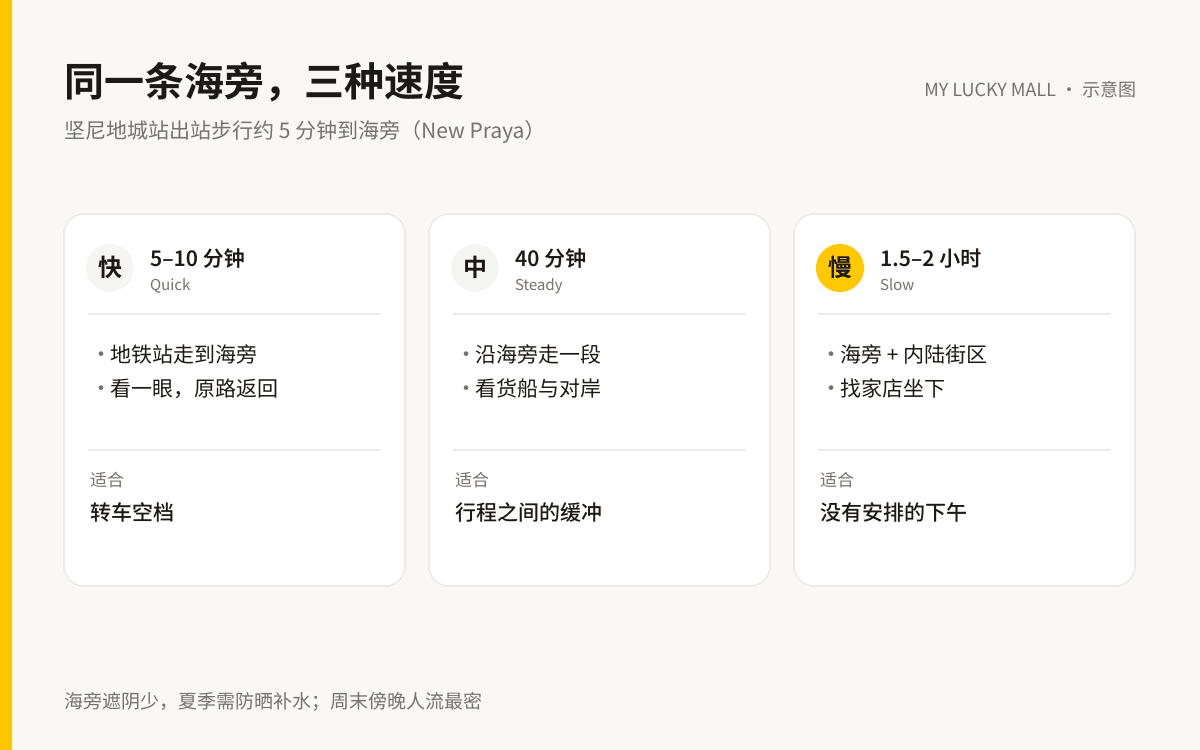
- •The same stretch can be walked three ways: 5 minutes for a glimpse, 40 minutes for a stretch, two hours to sit down.
- •Weekday afternoon to evening is best; weekend evenings are the most crowded, the waterfront has little shade, and you need sun protection in summer.
- •Heading inland takes you into the old district where the market and tong lau interweave—this stretch feels more lived-in than the seaside.
Kennedy Town sits at the far western tip of Hong Kong Island and is the terminus of the MTR Island Line. Walk north from the station for a few minutes and the sea appears at the end of the street. The distance is almost unreal—you leave the station, haven't even decided what to do, and the sea is already there.
It isn't on most people's Hong Kong itineraries, and precisely because of that, the area still keeps the lived-in feel of an old district: wet markets, tong lau, minibus stops, and hardware shops squeezed onto the same street as coffee shops and bakeries that have opened in recent years. Nobody redesigned this place for tourists, so it still looks like people actually live here.
If you're looking for a place where you don't have to accomplish anything, Kennedy Town is a good answer.
Location and how to get there
Kennedy Town is at the western end of Hong Kong Island, and the MTR Island Line terminates here. From the station exit, it's about a 5-minute walk to the waterfront (New Praya). Its identity as a terminus is practical: you don't need to figure out which direction to go—just ride to the end.
Because it's the terminus, the carriages are usually already empty, and the crowd leaving the station isn't as hurried as at Central. That feeling of "no next stop" actually sets the pace of the area before you've even arrived.
One waterfront, three speeds
The waterfront is a very plain seaside promenade. No large installations, no must-photograph landmarks—just the sea, railings, benches, and people out for an evening stroll. The same path can be walked in three completely different ways.
- Fast: walk from the station to the sea in five minutes, take a look, and turn back. Good for a gap between transfers.
- Medium: walk a stretch along the waterfront, watch the cargo ships, the people fishing, the direction of the opposite shore—about forty minutes.
- Slow: find a shop nearby and sit down, put your phone away for half an hour, then walk back along the waterfront.
Way of walking | Duration | Route | Suitable for |
|---|---|---|---|
Fast | 5–10 minutes | Station → waterfront → back the same way | A gap between transfers, just want a glimpse of the sea |
Medium | 40 minutes | Walk east along the waterfront for a stretch, then turn back | A buffer between itinerary items, take a few photos |
Slow | 1.5–2 hours | Waterfront + inland blocks + find a shop to sit in | An afternoon with nothing planned |
Neighborhood structure: the sea at one end, daily life at the other
Kennedy Town's spatial structure is very clear: the sea is to the north, the wet market and old buildings to the south, with several parallel streets in between. This structure determines how you walk—you can go to the waterfront first, then retreat inland, moving from open space into density.
The market area is the most densely lived-in part of the district. Mornings are for grocery shopping; by afternoon the stalls have mostly packed up and the streets quiet down. The tong lau are mostly five or six stories, their facades old but still in use; the shopfronts below have changed hands several times, with hardware, herbal medicine, laundry, noodle shops, and coffee shops all coexisting.
When is the best time to go
The effect of time of day on the experience is more obvious here than at most attractions. Once the crowds arrive, the waterfront's "emptiness" disappears.
Time of day | Foot traffic | Feel | Recommendation |
|---|---|---|---|
Weekday morning | Light | Quiet, flat light | Good for photos and long walks |
Weekday afternoon | Medium | Side light, layered sea surface | Best overall time for the experience |
Weekday evening | Medium to heavy | Sunset is due west, strong backlight | Good for sitting, not for photos |
Weekend afternoon | Heavy | Waterfront benches are basically all taken | Avoid if you want quiet |
Weekend evening | Heaviest | Crowds overlap with dog-walking peak | Only suitable for passing through |
There's also a practical factor: the waterfront has little shade. Walking this stretch at midday in summer is noticeably sunny, so bring a hat and water. In winter the sea breeze is strong and standing around gets cold—a jacket matters more than you'd think.
A route that extends inland
If you have close to two hours, you can follow the order below. It's all on foot; no transport needed.
- After leaving the station, head north first, walk to the waterfront, do nothing, and stand there for five minutes.
- Walk east along the waterfront for a stretch, until you see the railings toward the pier get denser, then turn back.
- Return to the blocks and head south through one or two streets, into the narrow streets between the market and the old buildings.
- Find a shop where you can sit down, have something to drink, and observe which way the foot traffic on the street flows.
- If you still have time, continue south toward the Hill Road area, where the terrain starts to rise and the view changes.
The key to this route isn't "what you see," but letting your pace slow down naturally. Most of the pleasure of Kennedy Town happens in those ten minutes you didn't plan.
How to plan eating and drinking
The dining structure here is "small shops first, chains second." Noodle shops, roast meat shops, cha chaan tengs, and coffee shops are mixed on the same street, with a narrow price range. Peak hours are concentrated between noon and 1:30 pm, and after 7 pm.
If you just want a drink, pick a small street-side shop and sit for ten minutes before leaving; if you want to stay longer, find a shop with window seats, where the sea breeze blows in from the street corner. On weekend afternoons many shops have a wait; on weekday afternoons you can basically sit down right away.
How it differs from two other seaside spots
Hong Kong has many places to see the sea, but their characters differ greatly. Comparing three of them side by side makes it easier to judge which one you want right now.
Place | Spatial character | Foot traffic | Suitable for |
|---|---|---|---|
Kennedy Town waterfront | Narrow, long promenade; old district pressed against the sea | Mostly local residents, few tourists | Walking, sitting, doing nothing |
Tsim Sha Tsui waterfront | Wide promenade, with the Hong Kong Island skyline across the water | Dense with tourists | Night views, seeing the classic view all at once |
West Kowloon Cultural District | Large lawns and a cluster of museums | Mostly exhibition-goers | A half-day itinerary, switching between indoors and outdoors |
You can visit all three, but don't schedule them on the same day. Their value lies in "staying," and rushing through cancels out their advantages. For the West Kowloon route, seeWest Kowloon exhibitions: spending an afternoon between M+ and the waterfront promenade.
Frequently asked questions
Are there any must-visit photo spots in Kennedy Town?
No. The appeal of this area is precisely the lack of signature installations. If you need to "photograph something" to feel you've completed the visit, this place may disappoint you; if what you need is a stretch of time with no tasks, it's very suitable.
Is it suitable for bringing children or elders?
The waterfront promenade is flat, suitable for strollers and slow walking; but there's little shade and it's windy, so prepare for both summer and winter. The market area inland has narrower streets, so pay attention when it's crowded.
Where else can I go nearby on the way?
To the east you can connect to the old district around Sheung Wan, where the density of dried seafood shops, herbal medicine shops, and coffee shops is higher; for the route, seeTea and coffee in Sheung Wan. To the south are Hill Road and residential areas, where the slope rises noticeably—good for those who want to walk a bit more.
Next steps
If you want to turn this kind of "no-rush" experience into a concrete outing, seeWhat is UNBOX; for more neighborhood clues, seeDiscover, or you can first readWhat is MY LUCKY MALLto learn what the platform does.
Key facts
- Location
- New Praya, Kennedy Town, Hong Kong Island
- Transport
- MTR Island Line, Kennedy Town Station, about a 5-minute walk
- Suggested stay
- 1.5–2 hours
- Best time
- Weekday afternoon to evening
- Suitable for
- People who like old-district street scenes and don't rush their itinerary
- Note
- The waterfront has little shade; in summer you need sun protection and hydration
Sources
Related stories

How to give a blind box as a gift? Choosing by budget, occasion, and recipient preference
Who is a blind box suitable for, and who isn't it for? How to set a budget, match the occasion, and avoid "gave it but never used it"? This article offers a three-step test, four typical recipient profiles, and common mishaps, plus how to follow up after giving.
What is UNBOX: how does one unboxing turn into a city discovery
UNBOX is MY LUCKY MALL's curated blind box: each box combines 3–5 items selected by algorithm and human curation, including physical items and some local experience vouchers, with the total value of the items guaranteed to be no less than the purchase price. This article explains the five-step process, what's in the box, the role of surprise items, and how it differs from traditional blind boxes.